
Americans really, really don’t like data centers
Should we have them anyway?

Please tap the {{heart}} button, which helps new readers find All Predictions Wrong.
When your writer grew up in Buffalo, New York, that city was the buckle on the Rust Belt. The sprawling Tonawanda Engine factory of General Motors, walking distance from my boyhood home, encapsulated Buffalo of the period.
Today within a walk or short drive from my boyhood home are four major data center projects, including one of Google’s largest. They represent replacing smokestacks with clean industry that is future-facing.
Sound good? The data centers are absolutely hated by community activists.
From my boyhood home you can walk to the Huntley Generating Station, a coal-fired power plant that opened in 1916 and shut down in 2018; walk to Tonawanda Coke, a coking facility that opened in 1917 and closed in 2018. Developers have filed for permits to buy both parcels, demolish century-old pollution-spewing heavy industrial structures and replace them with clean, neat data centers.
The Huntley and Tonawanda Coke sites are excellent locations for data center construction – plenty of electricity from the nearby zero-emission hydropower facility at Niagara Falls, plenty of water as both front the roaring Niagara River.
Yet even though the plans would swap out archaic facilities for clean tech in a sector with job-growth potential, there are intense campaigns against the proposals.
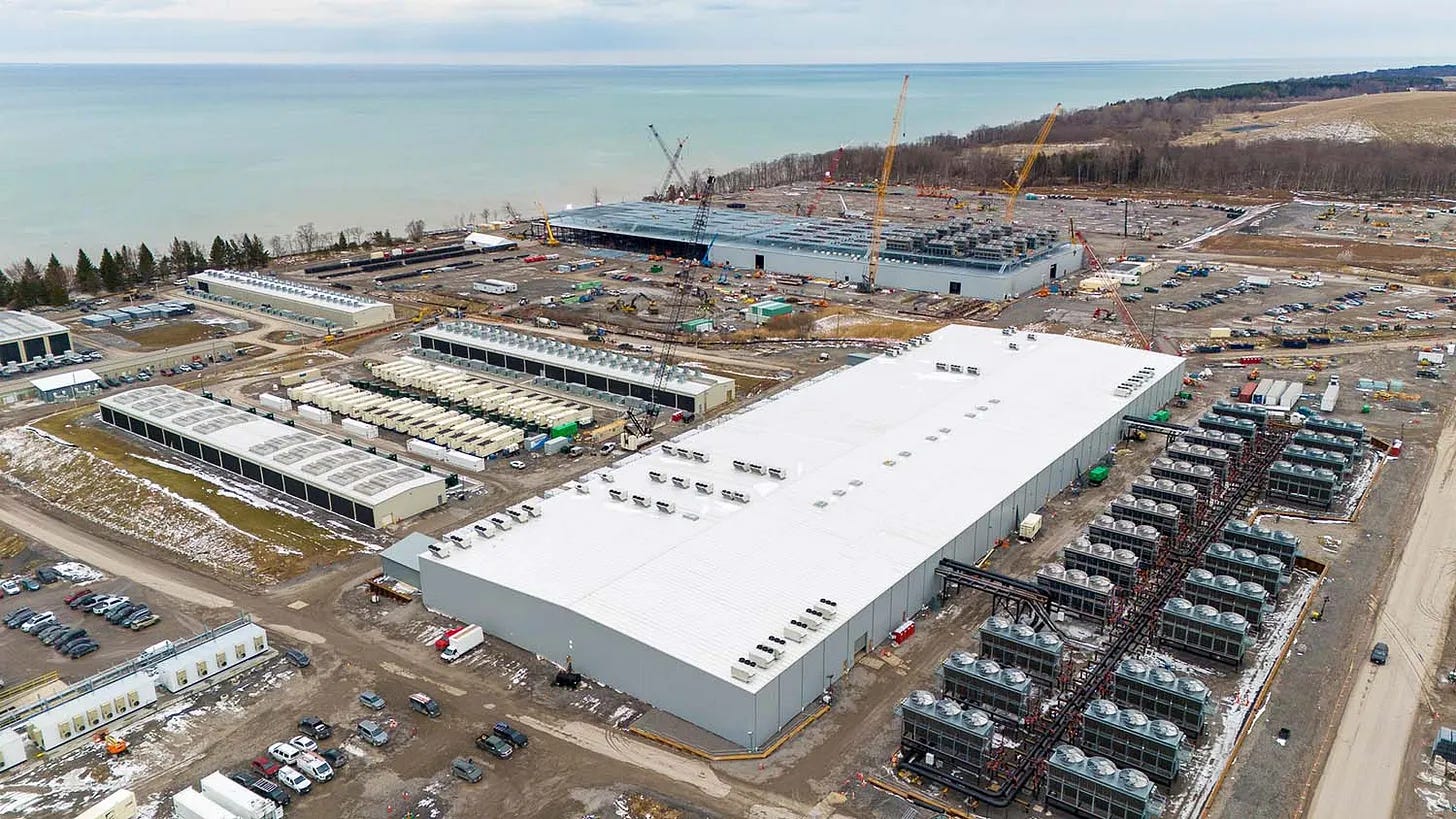
The Google data center a short drive from my boyhood home. Photo courtesy TeraWulf.
A short drive from my boyhood home takes you to Barker, New York, along the shore of Lake Ontario. A decommissioned coal-fired power station has been demolished and is being replaced by one of the world’s largest data centers.
Alphabet (Google) is the anchor tenant in terms of leasing AI output and space for data racks. (A “colo,” in slang.) Anthropic has a share of the computing power reserved. Young enterprises with zoomy names such as TeraWulf, Core42 and Fluidstack are involved.
TeraWulf is representative of the emerging field – founded as a bitcoin-mining startup, it pivoted to data centers, which are far more important to the national economy.
Most electricity needed by Google’s Barker, New York, data campus would come from clean Niagara Falls hydropower, while Lake Ontario offers ample water.
Nevertheless the project spurred controversy. As awareness dawned that the finished campus will span 410 acres and consume as much electricity as the entire state capital at Albany, New York leaders scrambled to announce opposition.
Saying it’s too late to stop this particular plan, Gov. Kathy Hochul just imposed a one-year moratorium new permits for data centers. NIMBYs are using the moratorium as one tool to fight another “hyperscale” AI data center proposed in another part of New York state by a firm with the zoomy name Stream Data, which specializes in “data clustering.” Whatever that is!
