
Even under Trump, infrastructure progress remains slow
The Reflecting Pool fiasco reflects a larger problem

Please tap the {{heart}} button, which helps new readers find All Predictions Wrong.
What follows is actual news, not a comedy sketch:
In January a sewer main burst along the Potomac River near the White House, releasing 240 million gallons of raw sewage into the water.
The utility district responsible learned in 2018 that the line was close to failure, and scheduled a renovation project.
Now it’s eight years later and raw sewage is pouring into the Potomac. The renovation never happened. Why? Permits were held up for environmental review.
For eight years federal and state agencies blocked infrastructure work in order to consider the highly controversial question of whether keeping sewage out of a river would be good for the environment.
Don’t necessarily blame the progressive love of burdensome regulations. About half the years of dilatory review occurred with Donald Trump in the Oval Office.
Don’t even ask how much public money went down the drain for the all-out emergency response, versus the far lower cost of avoiding the emergency in the first place.
Environmental rules cause harm to the environment!
This is the extremely slow of pace of infrastructure progress in a nutshell.
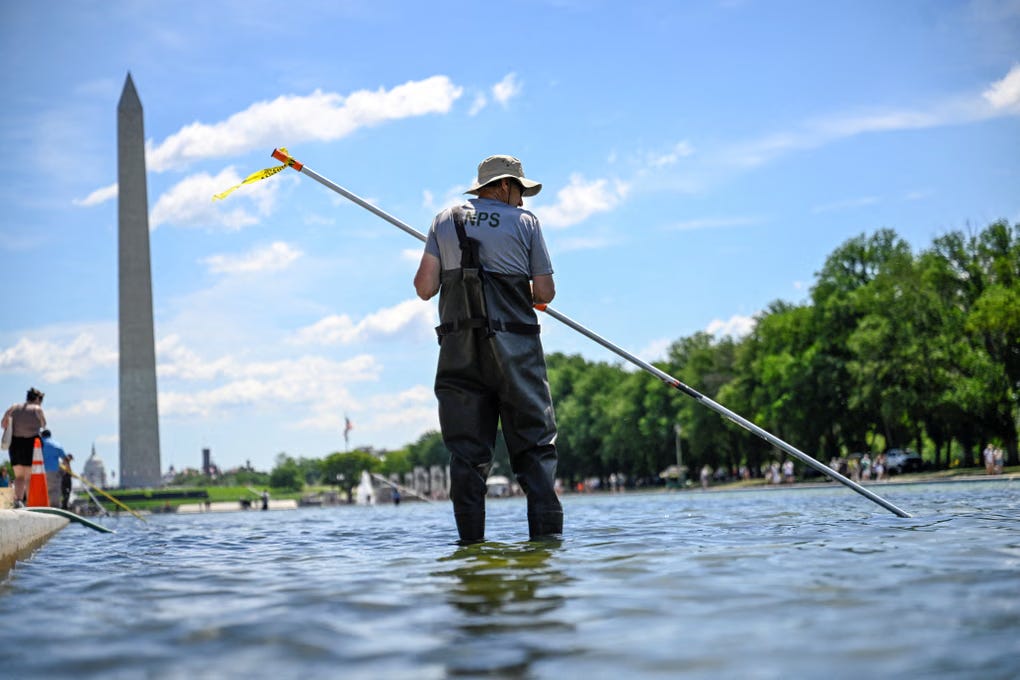
The national pool boy. Photo courtesy Reuters.
North of the Potomac River are Maryland suburbs where many D.C. workers and politicians live.
For more than a decade two of the state’s counties have been struggling to build a highly subsidized light-rail trolley line that will connect Bethesda, Maryland, home to the National Institutes of Health and headquarters town of Marriott, with the University of Maryland flagship campus 16 miles away.
Three summers ago, in one of the first All Predictions Wrong, your writer showed the project – called the Purple Line – is so plagued by delays and cost overruns the price now exceeds that of an Apollo Moon mission.
Just to prove the overruns were no fluke, the Purple Line project has already taken longer than the entire Apollo program from starting day to “one small step” on the lunar surface.
Perhaps you will not be surprised to learn that three years later, the Purple Line has fallen even farther behind. Ground for the rails was broken in early 2017. Now the government authority responsible for the Purple Line says the first passengers won’t board till the end of next year – a decade to build a 16-mile trolley.
There is one tunnel and two miles that are elevated. All the rest is surface track (“grade level”), the easiest kind of rail to build. The rate of progress is less than a mile per year.
Other numbers for the Purple Line are equally depressing.
It’s taking twice as long to build the Purple Line’s 16 miles as it took to dig the 365 miles of the Erie Canal.
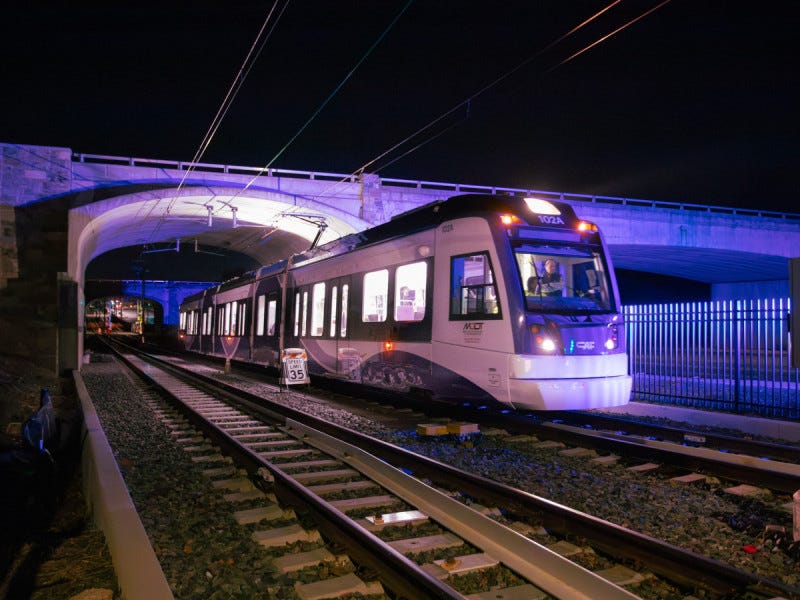
A Purple Line train. Too bad you can’t board. Photo courtesy WMATA.
Including the trains, the Purple Line looks like it will cost a breathtaking $587 million per mile. (All money figures have been converted to 2026 dollars.) That’s double the price per mile of London’s new Liz Line, which is mostly underground, has faster trains and offers more passenger features. That’s treble the price of the new Line B extension of the Toulouse, France, Metro, which is entirely underground.
NIMBY litigation, environmental permit rules, politically driven change orders in design, and the sluggishness of any form of construction in today’s United States impeded the Purple Line.
That the slooooow-moving project is happening a short distance from the White House and the United States Capitol speaks volumes about how red tape and process costs dominate contemporary infrastructure initiatives.
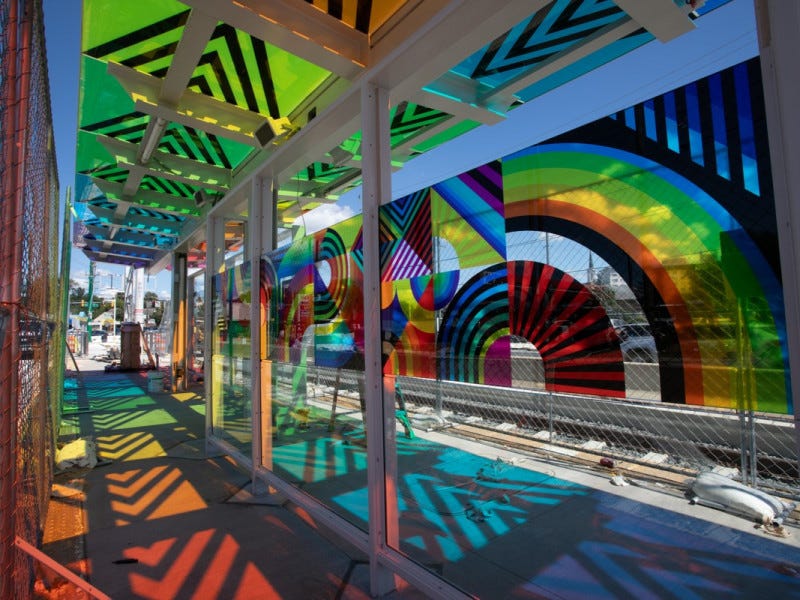
A Purple Line station near the nation’s capital. Too bad no trains come through. Photo courtesy WMATA.
Add a punchline: a few miles from the Purple Line trolley right of way, District of Columbia city government just shut down its trolley.
Opened 2016, the DC Streetcar ran for a decade, operating only slightly longer than it took to build. So few riders boarded that even the subsidy-loving District of Columbia government had to admit the system was a bust.
There is a significant difference between the DC Streetcar and the coming Purple Line. D.C.’s trolley ran along a regular streets, the way many European streetcars run. American drivers are not accustomed to yielding to trolleys, as are European drivers. Traffic and illegal parked vehicles often brought the DC Streetcar to a standstill.
The DC Streetcar peaked at 3,300 riders per day in its best year – not enough to make economic sense. Purple Line assumptions are based on 60,000 riders daily – nearly 20 times what was actually achieved by a trolley system nearby.
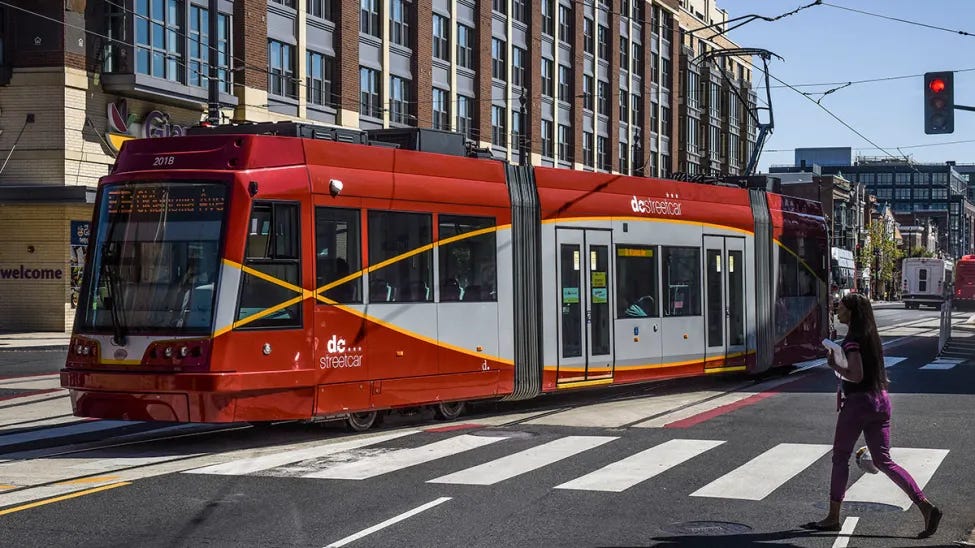
Amsterdam? Brussels? One of the streetcars the District of Columbia just shut down. Bill O’Leary for Washington Post.
A year ago All Predictions Wrong looked at the toxic interaction of U.S. environmental law, NIMBYism and politics that is slowing and often stopping needed infrastructure and housing.
