
Lift the Iran blockade
For decades the United States Navy protected freedom of navigation. Then it staged a blockade.

To readers: Normally All Predictions Wrong appears on Friday. Am publishing this one early because of relevance to an unfolding news event.
Many noted the irony: the United States attack on Iran led to the Strait of Hormuz being closed, then Washington demanded the Strait reopened as a condition of peace.
Setting aside whether the attack was wise or foolish, American action caused the global supply-chain problem the United States now condemns.
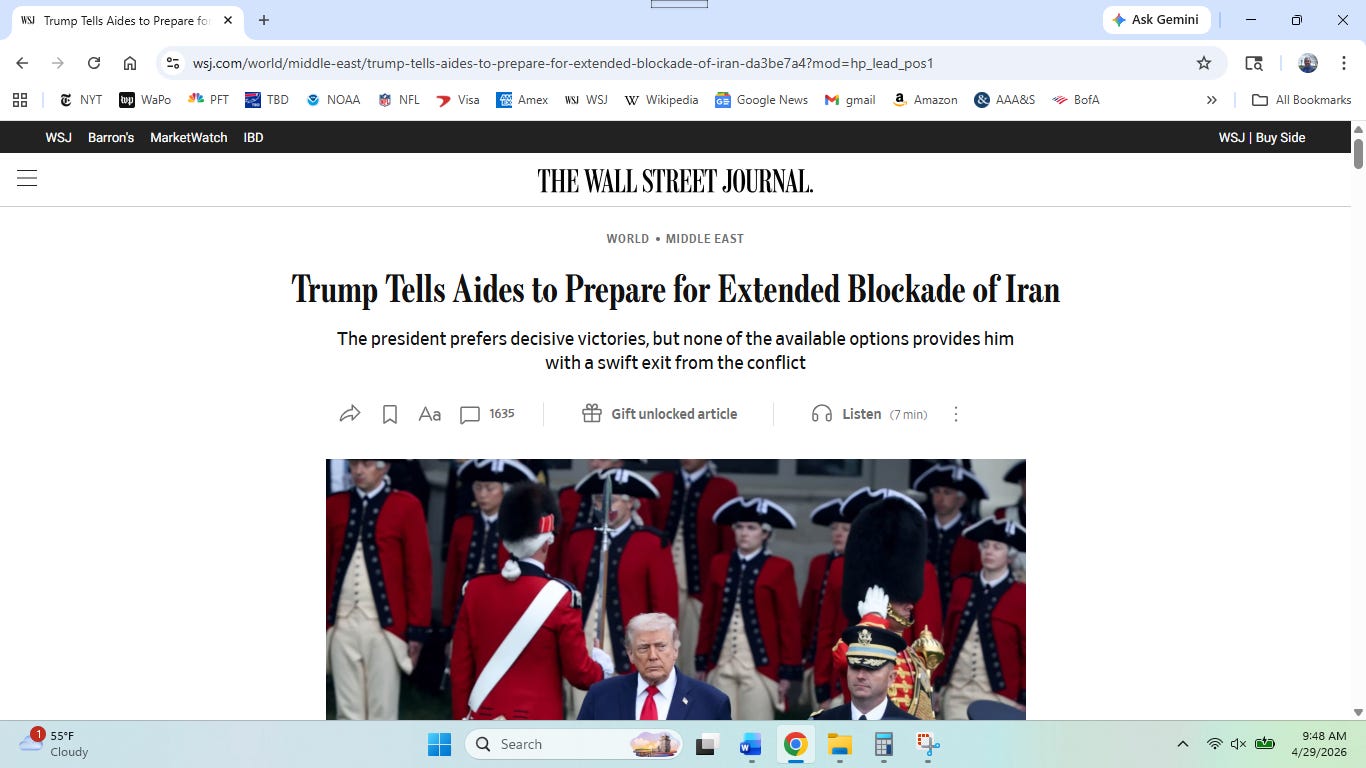
To increase pressure on Iran, Donald Trump ordered the United States Navy to blockade that nation’s ports. As of early May, the blockade was expected to be ongoing until a peace deal may be reached. TRUMP TELLS AIDES TO PREPARE FOR EXTENDED BLOCKADE OF IRAN, the Wall Street Journal headlined a few days ago.
Blockading might sound like an antiquated tactic from the days of wooden sailing ships. During the Seven Years War the Royal Navy blocked the west coast of France and came all the way across the Atlantic to blockade New France, for example.
Modern warships have been employed to blockade, too. Blockades were a major factor in both world wars. With United Nations approval a coalition of navies – the United States, Canada, Britain, France – blockaded Iraq for several years as punishment for the invasion of Kuwait.
In the period before Pearl Harbor, the United States closed the Panama Canal to Japanese vessels. This was not strictly speaking a blockade, but reduced Japan’s ability to trade.
The American blockade against Iran is now in its fourth week. Israel has been blockading Gaza since 2009. Much of Taiwan’s military strategy turns on preventing China from blockading the island. Iran’s closing of the Strait of Hormuz has the same impact as blockading those waters, only is enforced by drones and mines rather than warships.
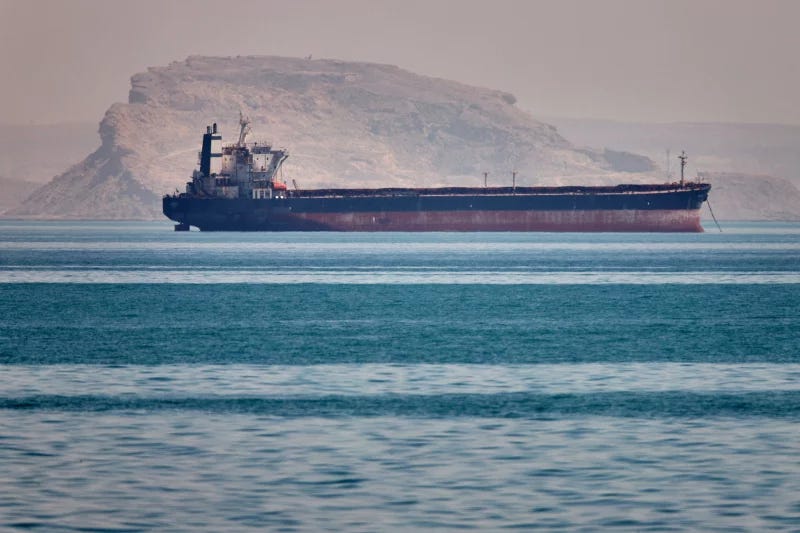
Tanker at anchor off Iran in the Persian Gulf. Photo courtesy NPR.
Blockades have mattered for centuries because large amounts of goods – foodstuffs, tea, spices, gold – have been in water transit for centuries.
Long ago the Roman Empire shipped grain by the hundreds of tons across the Mediterranean. The original 13 colonies relied on water-borne shipments from England. There are many other historical examples.
Today the global economy depends on thousands of container ships, tankers and bulk carriers coursing the seas. The more interdependent the world becomes – and in the main, interdependence is good – the more threatening the word “blockade” grows.
On paper blockades are subject to international law, as a practical matter are determined by who has the warships and missiles.
Blockading is an act of war. International law accepts this if the blockade is done for self defense – if the blockade is an act of aggression, then it’s a war crime.
Trump has said several times the United States started bombing in self-defense because Iran was about to attack American installations in the Middle East. That would make the bombing campaign and naval blockade legal under international law. Trump often shows disdain for diplomatic niceties: here, follows them.
But is it a war? One might presume that if you’re bombing another nation and blockading its ports, you’ve gone to war. Trump and Secretary of War Pete Hegseth insist the United States has not gone to war.
The Constitution says only Congress can declare war. Resolutions to declare war have been defeated handily in the Senate, by close margins in the House. Trump even says the quiet part out loud: “You call it a military operation, that way you don’t have a war and you don’t need approval [from Congress].”

Blockading by modern navies began in 1853 during the Crimean War, a campaign little regarded in the United States because America was not a party.
Nicholas I initiated the war hoping to seize territory from the declining Ottoman Empire and to have Russian Orthodox Christianity prevail over French and Italian Catholicism in the Holy Land, the Tsar wanting to be seen as the great defender of Christendom.
Launching the Crimean War caused previously fractious European allies to unite against the Tsar – exactly the effect launching the Ukraine War is having for Vladimir Putin, who talks about being the defender of Christendom.
CORRECTION. Using metonymy, the original of this essay said European allies “united against Moscow.” Reader RKH corrects that during the Crimean War, the capital was Saint Petersburg. Moscow has been capital since 1918.
During the Crimean War British, French and Turkish warships blockaded the Baltic and Aral seas, causing Russia’s economy to stagnate. The Royal Navy made its combat debut of screw propellers (rather than sails or sidewheels), the first such warship being the wonderfully named Agamemnon. This innovation set in motion the metal warship arms race that would dominate military politics for decades.
Also set in motion was the forgotten war of 1857 between Iran and Great Britain. By 1941, the United Kingdom and Soviet Union would jointly invade Iran. The Persians have had a number of military confrontations with today’s great powers.
Ultimately an alliance of Britain, France, the Ottomans and Italian factions defeated Russia in the Crimean War. After the 1856 Treaty of Paris ended the conflict came the Declaration of Paris, concerning maritime rules.
The Declaration of Paris called blockading an act of war, banned privateering and said only sovereign nations could be blockaded. In some respects the Declaration of Paris was the onset of international law, since it sought to bind not just the signatories but all nations.
